XMM-Proposal-Agent · cycle-obs9 · I028 · archive track

Is the soft X-ray temperature difference between M33's inner and outer disk a real, reproducible projected signal?

This is not "re-analyze all satellites." This page asks only one judgment: is the existing XMM EPIC-pn archive worth completing a strict, falsifiable inner-outer disk projected effective-temperature contrast qualification?

Current PI decision: whether to invest in subsequent R3/R6 archive qualification. It is not a HEAVY authorization, not a new observation request, not a feasibility conclusion, and does not commit to any exposure time.

中文版本

01 · Question

The one-sentence question

In source-controlled, response-qualified M33 inner-disk XMM EPIC-pn archive data, does the pre-frozen inner region have a materially higher projected effective temperature than the outer region?

The only primary quantity to report

ΔT,pn = ln(kTin,pn / kTout,pn)

A positive sign only means: under the same frozen model, response, and nuisance conditions, the inner region's fitted effective temperature is higher. It is not a 3-D radial temperature profile, nor a disk-only temperature, density, abundance, or heating mechanism measurement.

02 · Why it matters

Existing literature sees radial variation, but has not answered this narrower question

Owen & Warwick (2009) published source-masked residual emission, an integrated two-temperature spectrum, and a 2′–14′ soft X-ray surface-brightness/hardness profile for the M33 inner disk. They did not provide an inner-outer annular thermal contrast dominated by one EPIC-pn response family; and they explicitly noted that at this inclination the data cannot separate disk emission from a lower-halo component.

Therefore, what is worth answering is not "is this the first discovery of M33 diffuse emission," nor "which feedback mechanism wins." It is a more testable premise: after modern point-source control and background/response qualification, does a sufficiently large, positive projected temperature contrast still exist? If not, this constrains the practice of reading old hardness-radial trends directly as material thermal structure; if yes, it only establishes the measurement prerequisite for subsequent physical interpretation.

Whose published conclusions are constrained?

Owen & Warwick (2009)'s radial hardness / integrated thermal baseline, and subsequent work that infers disk thermal structure from such profiles. The new result does not overturn that paper; it tests the unfinished step of whether the "inner-outer thermal parameter contrast is material."

What must never be inferred from this step

One cannot select feedback, mixing, accretion, or halo origin from ΔT,pn; nor can one declare disk/halo separation. If disk–halo mixture makes this quantity unidentifiable, the result must be INCONCLUSIVE.

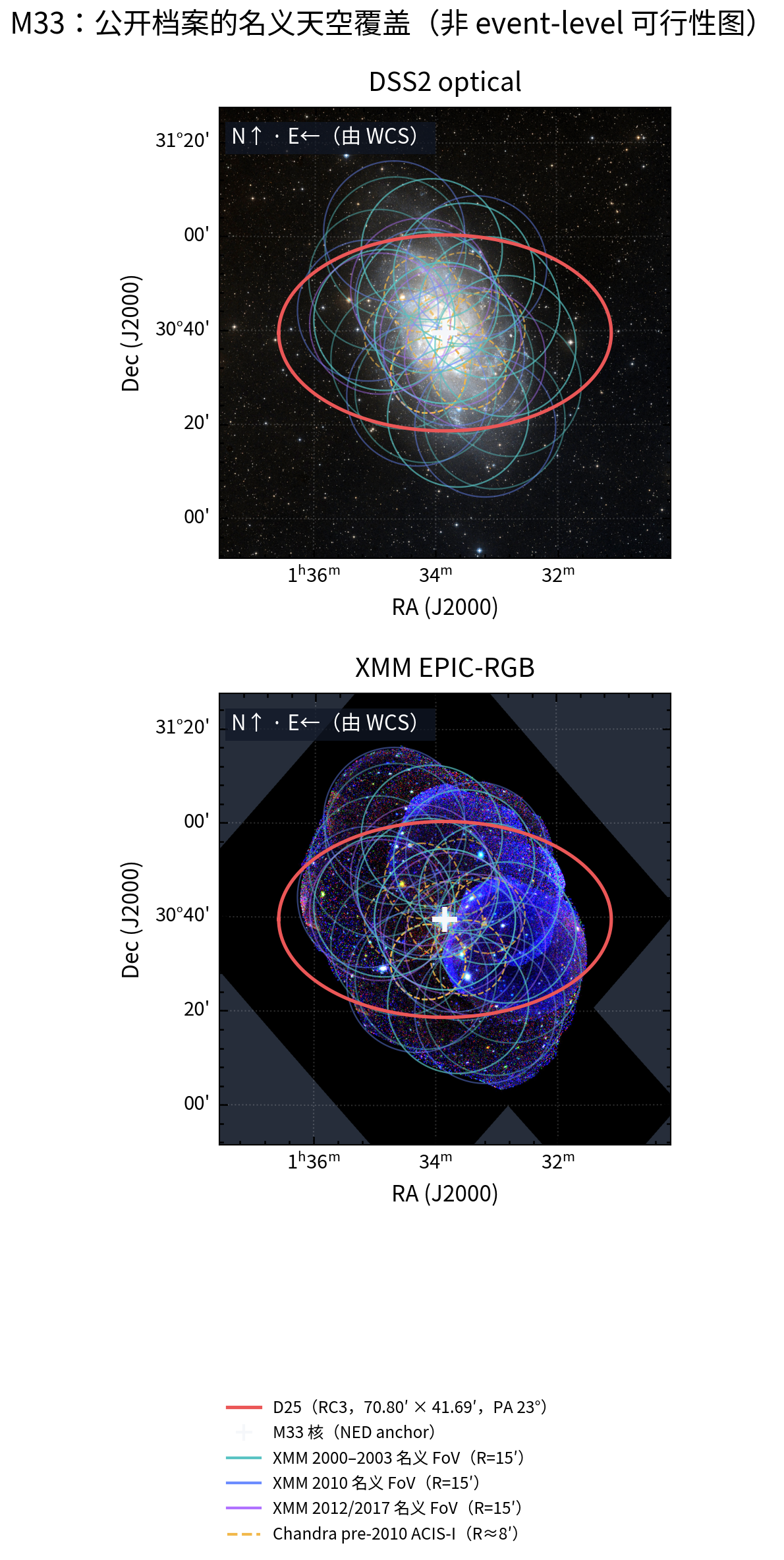
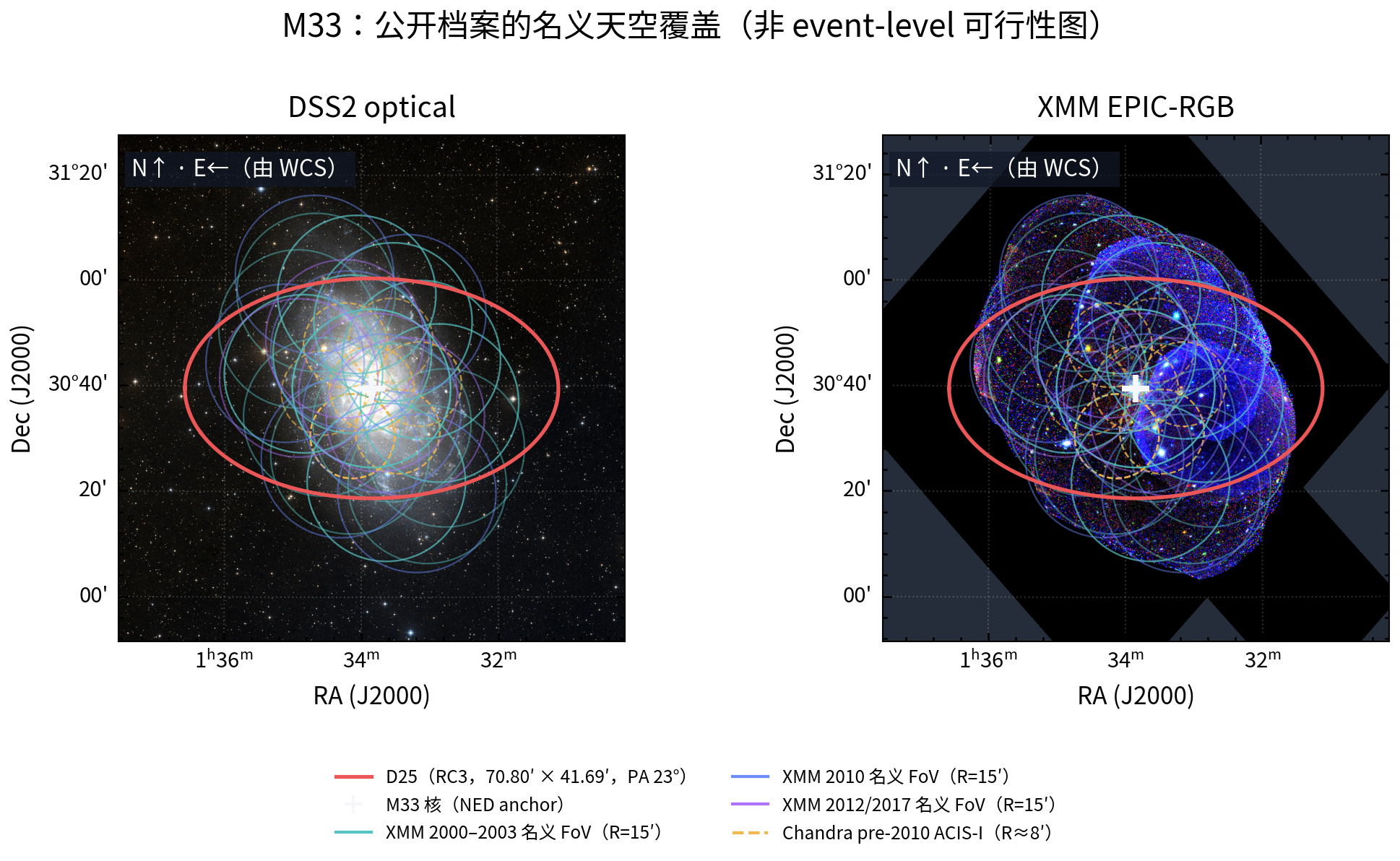
M33 DSS2 optical and XMM EPIC-RGB real WCS two-panel; North up, East left, showing D25, 35 filtered XMM nominal 15 arcmin FoV, and 25 pre-2010 Chandra ACIS-I nominal 8 arcmin FoV.
The archive is a real mosaic, not a single central field. The figure shows DSS2 optical and ESDC XMM EPIC-RGB in the same M33-centred real WCS; the WCS CDELT1<0, CDELT2>0 gives North-up / East-left. Solid/dashed circles are nominal sky FoV recomputed from the XSA/HEASARC metadata pinned to this page, not clean GTI, chip-gap, mask, vignetting, ARF/RMF, or background-qualified footprints. The right panel's asinh stretch is for display only: zero coverage is blue-gray and must not be read as low surface brightness, exposure correction, or flux.

Download 1-column PNG · WCS and selection geometry JSON

03 · What data exists, what evidence is missing

Coverage is rich; an executable measurement is not yet established

Public metadata recomputationWhat it showsWhat it does not show
35 diffuse-relevant XMM ObsIDs; pn / MOS1 / MOS2 scheduled science exposure = 1,161.833 / 1,224.096 / 1,208.599 ksAn EPIC mosaic covering the M33 disk exists, from which a primary pn domain can be built from the same missionNot clean GTI, nor usable source/background counts, chip support, or response comparability
25 pre-2010 M33 ACIS-I ObsIDs; scheduled exposure = 1,426.570 ksCandidate input for deep point-source catalogue / mask provenanceWill not enter the primary temperature estimator, nor can it replace pn response
XMM nominal FoV R=15′; ACIS-I shown with R≈8′Sky-level display of the inner disk's relation to a large number of archive pointingsNot detector footprint, post-mask area, or vignetting-weighted coverage

Necessary correction to an old premise: Current public XSA metadata shows an M33 field mosaic; it can no longer be described as a single-centre archive with "all XMM aimpoints within 0.4′ of the nucleus." This correction only changes the coverage representation on this page; it has not closed any Gate, nor proven any annular extraction feasible.

04 · Actual measurement and counterfactual

First prove the estimator is usable, then let an interval give the unique label

Before looking at the real inner-outer contrast, R3/R6 must freeze inner/outer projected supports, compact-source masks, unresolved-source treatment, pn event/channel domain, background/foreground/absorption/abundance nuisance, the positive materiality margin δT, and the interval confidence construction C. Only then can classification proceed from the ordered interval [LT, UT].

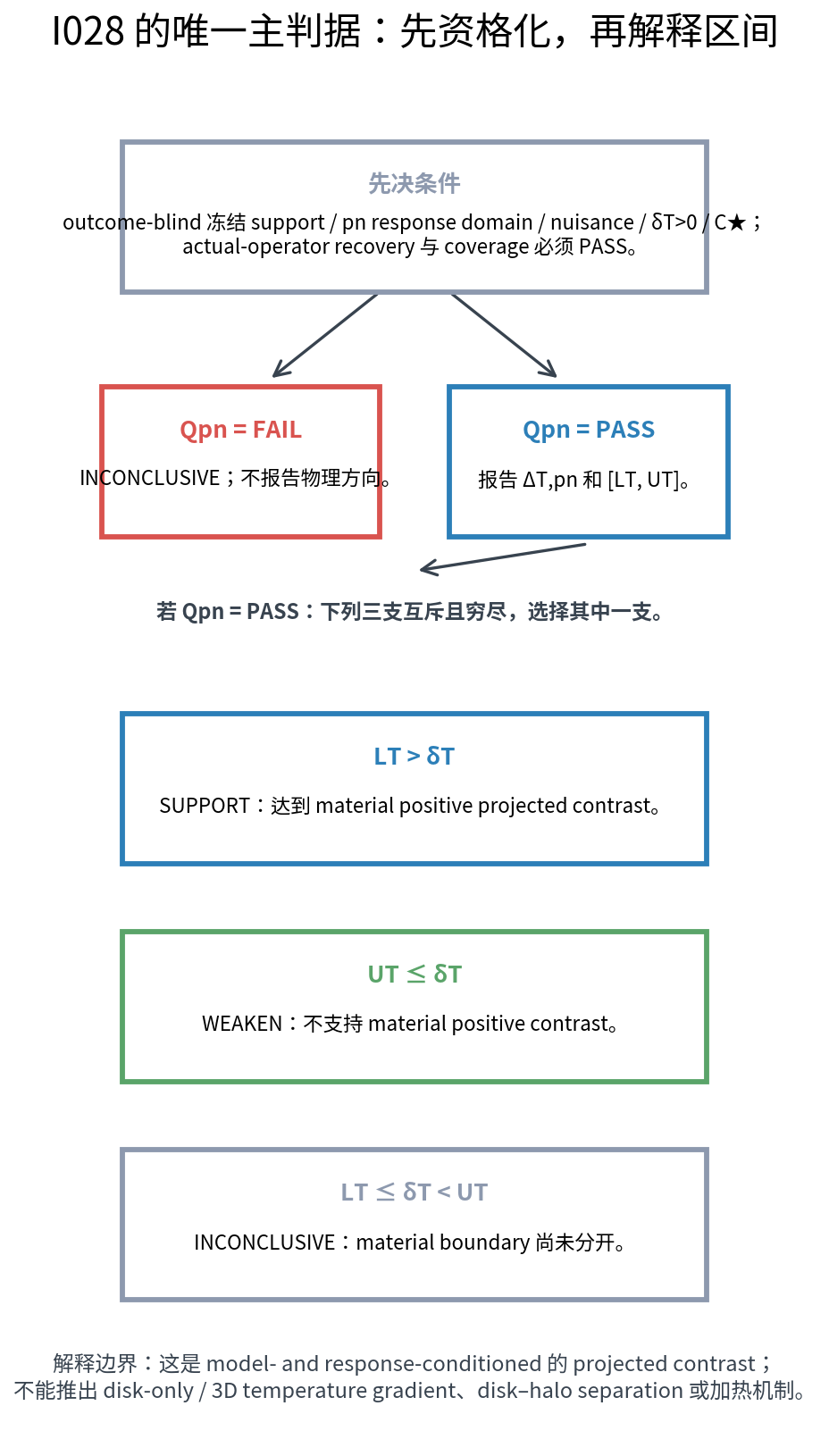
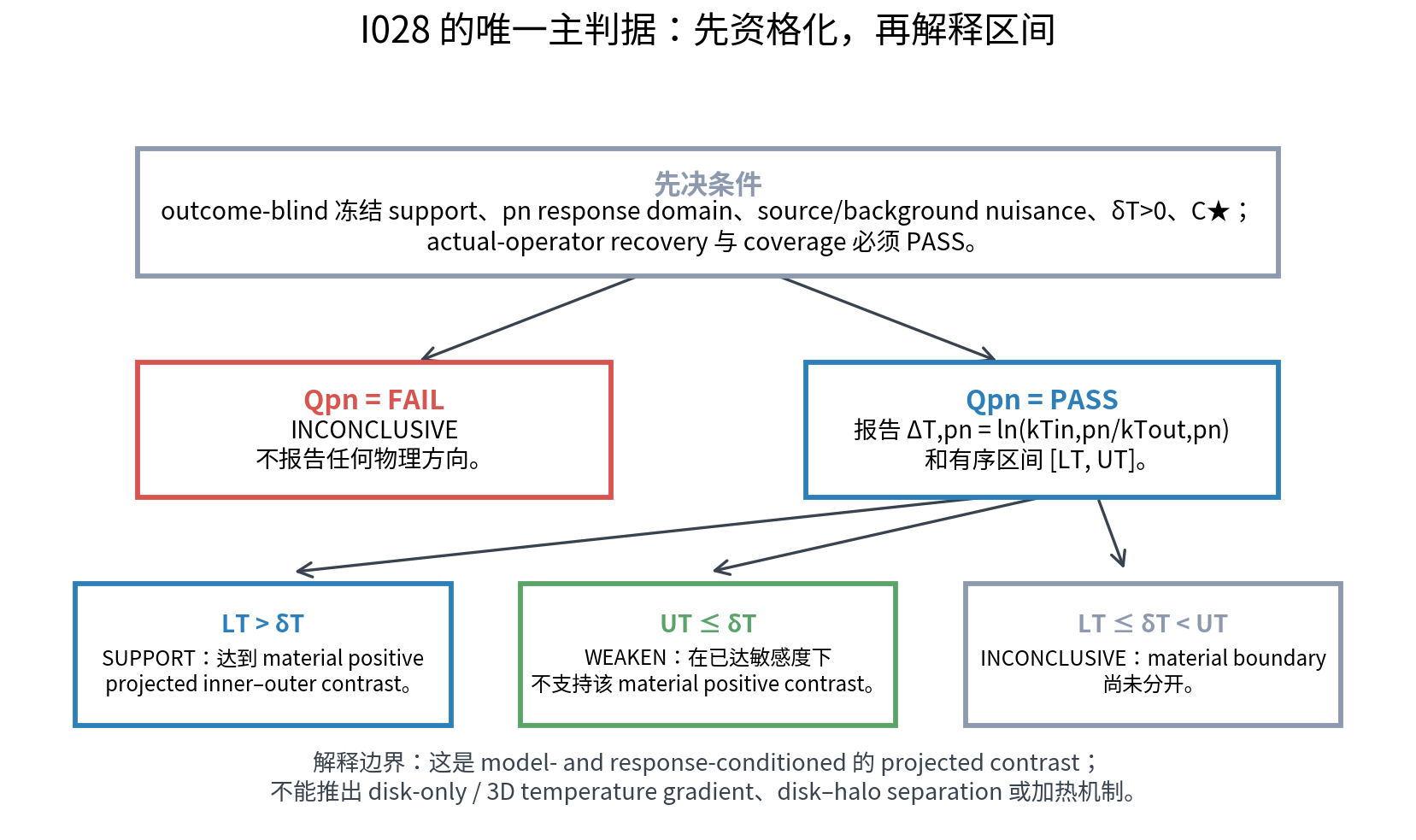
I028 decision contract: qualification failure is INCONCLUSIVE; after qualification passes, three mutually exclusive outcomes of SUPPORT, WEAKEN, and INCONCLUSIVE relative to the positive materiality margin.
This is not a discovery plot, but a fail-closed interpretation contract. Qpn FAILs if any of product, response, source control, identifiability, δT provenance, or recovery/coverage is missing; then the only legitimate result is INCONCLUSIVE. Only after Qpn=PASS do the three interval branches become mutually exclusive and exhaustive. The thresholds δT and C remain needs-data, so this page does not fabricate values.

Download 1-column PNG

05 · If the answer is reversed

A flat or insufficiently large contrast is still informative, but not proof of an "isothermal disk"

SUPPORT

Supports only: under a qualified pn domain and frozen nuisance, the inner region has a material positive projected effective-temperature contrast. It is a prerequisite for the next round of disk/halo/physical-model work, not a mechanism verdict.

WEAKEN

At achieved sensitivity, does not support a material positive contrast. It does not prove M33 isothermal, nor does it vote among feedback/mixing/accretion; the interval and achieved sensitivity must be reported together.

INCONCLUSIVE

If response, background, projection mixture, or recovery cannot make this scalar identifiable, the correct product is INCONCLUSIVE. It is not a null, nor can it be packaged as a "no variation" physical conclusion.

06 · Cost and unknowns

No telescope time cost; but processing cost or success probability cannot yet be honestly reported

This is an archive track: no new XMM time is requested. But "about 1.16 Ms pn scheduled exposure already exists" does not equal low cost or feasibility. What is now unknown includes each candidate ObsID's clean GTI, usable pn detector support, post-mask inner/outer area, soft-proton/QPB/CXB/foreground treatment, response operators, cross-filter composition, model identifiability, the source-qualified physical rationale for δT, and actual-operator injection/recovery/coverage. Without these, there is no reportable runtime, precision, power, count rate, or success probability.

Subsequent bounded workEvidence that must be producedImplication on failure
R3: P1/P4outcome-blind geometry/source-control manifest; exact pre-emption scopesupport inseparable or novelty not closed; must not enter primary label
R6: P2products/GTIs/responses/nuisance/interval contract for one qualified EPIC-pn domain, including projection-identifiability screenQpn=FAIL
R6: P3actual-response/background recovery, coverage, false-SUPPORT, near-margin power, and fragility sweepQpn=FAIL

07 · Judgment for the PI

Is this worth recovering from parked state into a bounded archive qualification?

The supporting case is clear: M33 provides a nearby, low-metallicity, non-starburst late-type disk with a rich XMM mosaic; old work already gives a traceable radial X-ray baseline; and the main question has been narrowed to a falsifiable scalar. The opposing case is equally clear: the most important physical risk is precisely projected disk/lower-halo mixing; plus source control, background, and response/recovery are not yet complete, so there is currently no provable material threshold or cost.

This page's conservative recommendation: If the PI believes "whether a material positive projected contrast exists" is itself worth knowing, then approve only entry into the above R3/R6 qualification; if the project is not worth first solving these basic identifiability problems, it should remain parked. Either way, this page does not authorize HEAVY, does not request new time, and does not treat archive inventory as a scientific result.
Provenance

The numbers, figures, and boundaries of this page

  • Public archive metadata: XSA xsa.v_public_observations and xsa.v_exposure, M33 centre RA=23.4620417°, Dec=30.6602222°, 0.5° cone; HEASARC chanmaster same cone. The raw CSV/ECSV, exact ADQL, fetch URL, and SHA-256 for the page figures are all fixed in the release manifest.
  • Literature scope: Owen & Warwick 2009; Plucinsky et al. 2008; Tüllmann et al. 2011. This is only the bounded source set already opened, not an absence claim over world literature.
  • Images: DSS2 color and ESDC/P/XMM/EPIC-RGB HiPS2FITS display inputs; all overlays converted from raw WCS. The XMM RGB intensity-only p0.5–p99.5 / asinh stretch is for display only.
  • This page is a communication artifact; it does not modify I028's Gate, status, score, Elo, track, or HEAVY authorization.